How to Play Roulette: The Rules, the Bet Types and the Table Explained
Roulette is simple to play and easy to misunderstand. Here is the whole game — the layout, the bets and the rules that quietly change your odds.
The game in one paragraph
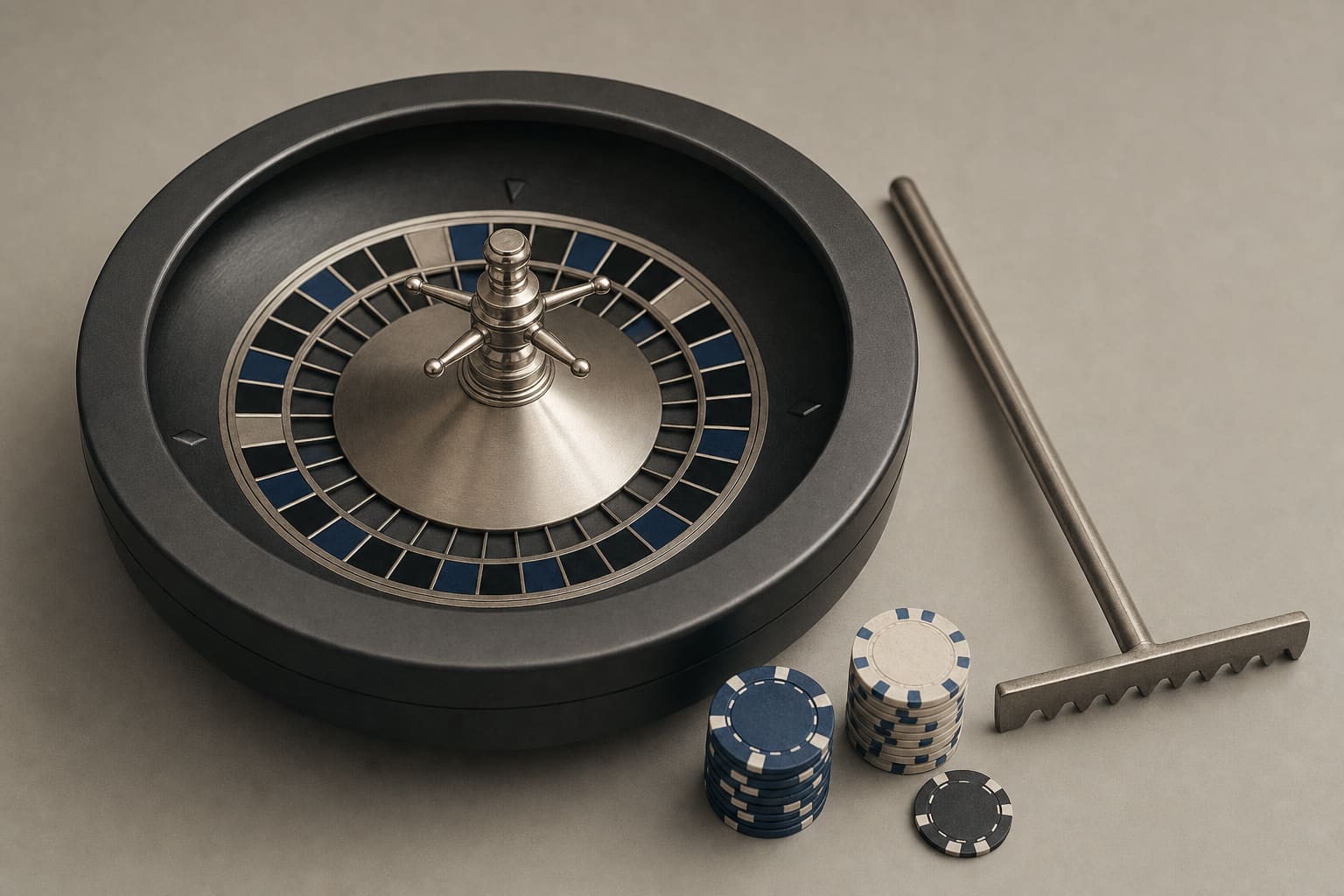
A roulette wheel has numbered pockets — 37 on a European wheel (0–36), 38 on an American wheel (with an extra 00). You bet by placing chips on the table layout, either on single numbers or on groups. The dealer spins the wheel one way and rolls the ball the other; where it settles decides the winners. Every spin is independent — the wheel has no memory, which is why no pattern of past results tells you anything about the next.
The bets you will actually place
The table splits into two families. Inside bets sit on the numbered grid — a single number (straight-up), the line between two (split), a block of four (corner), and so on. They pay a lot and land rarely. Outside bets sit around the edge and cover big groups: red or black, odd or even, the first or second eighteen, the dozens and the columns. They pay little and land often. Most newcomers start on the even-money outside bets because they win close to half the time and are the natural home for every betting system.
What trips people up is assuming one family is "better value" than the other. On a European wheel every standard bet carries the same 2.70% house edge — the difference between a straight-up and a red/black bet is entirely one of variance, not of value. Pick inside bets for rare big hits, outside bets for a slow, steady session; the long-run cost is identical either way.
How a round actually flows
A round has a rhythm worth knowing. You buy in for coloured chips unique to you, place your bets while the wheel is still open, and stop the moment the dealer calls "no more bets" as the ball slows. The dealer marks the winning number, clears the losing chips, pays the winners, and lifts the marker — only then do you place the next round's bets. On a French table, watch for the la partage marker on even-money bets when the ball lands on zero; it quietly hands back half your stake and is the best rule in the room.
Online the rhythm is the same but the clock is yours. A software table waits for you to press spin, so there is no dealer pace and no crowd, which suits players who want to think between bets. A live-dealer stream sits in the middle — a real wheel and a real croupier, but a betting timer that closes the table on a schedule you cannot slow down. The bets, payouts and edge do not change across any of these; only the tempo and the company do.
The wheel and the layout are two different things
They look like one object but they are two, and mixing them up is the most common beginner mistake. The wheel is the physical device with its numbered pockets — 37 on a European wheel — arranged so red and black alternate and high and low numbers sit apart rather than in a run. The layout is the felt grid where your chips actually go: the numbers 1 to 36 in three columns, zero at the top, and the outside boxes down the side. Numbers that sit side by side on the wheel are scattered across the felt, and numbers that sit side by side on the felt are scattered around the wheel.
That gap matters for one family of bets. Call bets such as the neighbours of zero or the orphans are defined by where numbers sit on the wheel, not on the layout, which is why they cover clusters of the grid that look random until you see them on the rim. For everything else you only ever read the felt. If you are weighing up which table to sit at, the single-zero versus double-zero question is covered on European vs American roulette.
A quick tour of the bet groups
Rather than repeat the full payout chart, here is the shape of it. Every bet is either a small group of numbers that pays big and lands rarely, or a large group that pays little and lands often, with a smooth range in between.
| Bet | Numbers covered | Payout |
|---|---|---|
| Straight-up | 1 | 35:1 |
| Split | 2 | 17:1 |
| Street | 3 | 11:1 |
| Corner | 4 | 8:1 |
| Column or Dozen | 12 | 2:1 |
| Red/Black, Odd/Even, High/Low | 18 | 1:1 |
Notice the straight-up line. It pays 35:1, but with 37 pockets the fair price would be 36:1 — that missing unit is the house edge, and it is baked into every payout in the table by the same proportion. The numbers, win chances and worked examples for each bet live on inside vs outside bets, and the reason the edge sits at 2.70% is set out on house edge.
The even-money rules that cut the edge in half
The one place where the table you choose genuinely changes your money is a pair of French rules on even-money bets. Under la partage, when the ball lands on zero you lose only half of any red/black, odd/even or high/low stake instead of the whole thing. That single rule drops the house edge on those bets from 2.70% to 1.35% — the best number you will find on any standard roulette table.
En prison is the same idea handled differently. Instead of returning half straight away, the dealer locks your stake "in prison" for one more spin; if that spin wins, you get the original stake back with no profit, and if it loses the stake is gone. Both rules apply only to the even-money bets — never to a straight-up, a corner or the dozens — and you will mostly meet them on French tables rather than the standard European or American games. For comparison, an American wheel adds a second green pocket and pushes the edge on the same bets to 5.26%, which is why the wheel in front of you is worth checking before the first spin.
Learn the parts
- Inside vs outside bets — every bet, its payout and its win chance.
- Roulette rules — la partage, en prison and the table etiquette.
- House edge — the cost built into the payouts.
- Betting systems — how to structure your bets once you know the table.
Questions about playing roulette
How do you play roulette in simple terms?
You place chips on numbers or groups of numbers, the dealer spins the wheel and drops the ball, and bets covering the winning pocket are paid. That is the whole game — the skill is in which bets you make and how you manage your bankroll.
What is the difference between inside and outside bets?
Inside bets are placed on specific numbers and pay more but win less often. Outside bets cover large groups (red/black, odd/even, dozens) and pay less but win more often. Full table on inside vs outside bets.
What are la partage and en prison?
Two French rules that return part of an even-money bet when the ball lands on zero, cutting the house edge to 1.35%. Explained on the rules page.