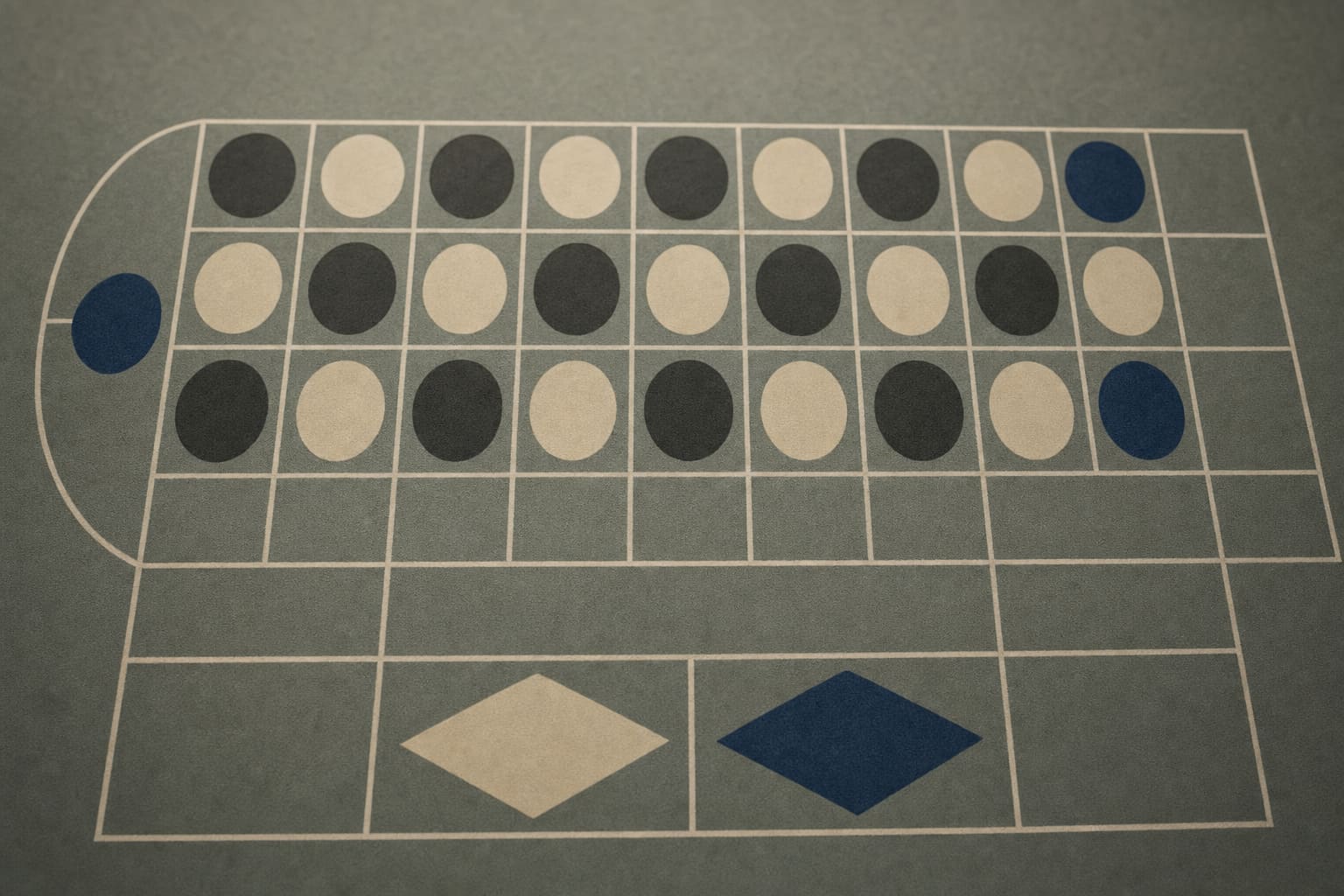
If you learn one thing about roulette odds before you sit down, make it this: the wheel you choose matters more than any bet or system. The comparison of European vs American roulette is the clearest example, because a single pocket separates a middling game from a costly one.
The one difference that changes everything
The difference between European and American roulette is a single green pocket. A European wheel carries the numbers 1 to 36 plus one zero — 37 pockets in total. An American wheel adds a second green pocket, the double-zero (00), bringing it to 38. Everything else — the bet types, the layout, the payouts — is the same. That lone extra pocket is the entire difference, and it is enough to move the odds sharply against the player.
European vs American roulette odds, side by side
Because the payouts are identical but the American wheel has more pockets, American payouts fall further short of the true odds. Here is the comparison.
| European | American | |
|---|---|---|
| Pockets | 37 (one zero) | 38 (two zeros) |
| Straight-up pays | 35:1 | 35:1 |
| True odds | 36:1 | 37:1 |
| House edge | 2.70% | 5.26% |
| Even-money win chance | 48.6% | 47.4% |
The European roulette odds are better on every line that matters. A 2.70% edge versus a 5.26% edge means that, over time, the American wheel costs you close to twice as much for exactly the same wagers.
Which has the better odds?
There is no contest. When you compare European vs American roulette on odds alone, the European wheel wins every time. Line up European vs American roulette on any measure a player cares about and the single-zero wheel comes out ahead. The difference is not subtle — it is the single largest odds decision available to a roulette player, larger than any choice of bet or betting system. If a casino offers both at the limits you want, choosing the European wheel is the easiest edge reduction there is.
Why the difference matters for strategy
Every betting system assumes a fixed house edge and works within it. Run the same system on an American wheel and you are simply paying a bigger edge on every bet — the difference compounds against you spin after spin. That is why we tell readers to settle the difference between European and American roulette first and choose a system second. Better still, find a French table, where la partage cuts the even-money edge to 1.35%.
How one extra pocket nearly doubles the edge
The house edge on a straight-up bet comes from the gap between what the bet pays and what it should pay. On a European wheel you win once in every 37 spins on average, and the win pays 35 chips plus your own stake back. Work through the expected value and you lose about one chip in 37, or 2.70%. The American wheel pays the same 35:1, but now you win once in 38 spins because of the second green pocket. That single change turns one losing case into two: you lose two chips in 38, or 5.26%. Nothing about the payout got worse — the casino simply added a pocket it does not pay you fairly for, and the edge roughly doubled.
| European | American | |
|---|---|---|
| Pockets | 37 | 38 |
| Straight-up win chance | 2.70% | 2.63% |
| Even-money win chance | 48.6% | 47.4% |
| House edge | 2.70% | 5.26% |
| Lost per $100 wagered | $2.70 | $5.26 |
The bottom row is the one to sit with. Over enough spins for the maths to show through, every $100 you put into action costs about $2.70 on the European wheel and about $5.26 on the American one. Same bets, same table, same evening — nearly twice the cost for picking the wrong wheel.
What the gap costs over a single session
The European vs American roulette gap only looks small until you spread it across a real sitting. Picture a player betting $10 a spin. A relaxed session runs somewhere around 40 to 60 spins an hour, so call it $600 wagered in an hour of play. On the European wheel the expected cost of that hour is roughly $16. On the American wheel the same hour runs closer to $32. Play three hours and the wheel you chose, not the bets you placed, accounts for something like a $48 difference in what the game quietly takes. Real sessions swing hard around those averages — you might walk away well up or well down — but the edge is the tide under the waves, and it always pulls the same way. Over a year of casual play the wheel alone can be the difference between a hobby that costs a little and one that costs a lot.
Where French roulette and la partage fit
French roulette is the quiet third option, and on the right bets it is the best of the lot. It uses the same single-zero wheel as the European game, so the base edge starts at 2.70%. The difference is a rule called la partage. When you have an even-money bet down — red or black, odd or even, high or low — and the ball lands in the zero, you lose only half your stake instead of all of it. That refund halves the edge on those bets to 1.35%, about as good as roulette gets anywhere on the floor. A related rule, en prison, does much the same thing: rather than take half, the casino locks your even-money bet in place for one more spin to settle. Both rules apply only to the even-money bets, not to straight-up numbers or the other inside wagers, so the headline 1.35% depends on how you bet. Tables carrying these rules are less common and often sit at higher minimums, but when a French table is open at a stake you are comfortable with, it is the strongest seat in the room.
How to tell which wheel you are sitting at
Telling the wheels apart takes about two seconds once you know where to look. Count the green pockets: one zero means European, a zero and a double-zero means American. On the felt, an American layout prints a 0 and a 00 at the head of the number grid, while a European or French layout shows a single 0. French tables add another giveaway — the outside bets are usually labelled in French (Rouge, Noir, Pair, Impair, Manque, Passe) and the la partage rule is stated on the layout or in the table rules. Online it is easier still: the game is named in the lobby, and you can open the rules panel before you stake anything. If you are still finding your way around the board, our guide to the rules of roulette walks through the layout piece by piece. The habit worth building is plain — check the zero count before the first chip goes down, every time, because no betting system you bring to the table can undo the pocket you failed to notice.
For the full picture, read roulette house edge explained, then choose from the roulette betting systems knowing which wheel you will be playing on.
Frequently asked questions
What is the main difference between European and American roulette?
The number of green pockets. A European wheel has one zero (37 pockets); an American wheel adds a second, the double-zero, for 38. That single extra pocket nearly doubles the house edge.
Which has better odds, European or American roulette?
European, clearly. Its house edge is 2.70% versus 5.26% on the American wheel — better European roulette odds on identical bets.
Do the bets and payouts differ between the two?
No. The bet types and payouts are the same. Only the pocket count differs, which is why the American payouts fall further short of the true odds.
Is there ever a reason to play American roulette?
Only availability. If both wheels are offered at the same limits, there is no odds reason to choose American over European.
How does French roulette fit in?
French uses the single-zero European wheel plus la partage, cutting the even-money edge to 1.35%. See roulette house edge explained.
How much more does American roulette cost over time?
About twice as much. The American wheel's 5.26% edge works out to roughly $5.26 lost per $100 wagered over the long run, against $2.70 on the European wheel — the same bets for nearly double the cost.
Is French roulette better than European roulette?
On even-money bets, yes. French uses the same single-zero wheel but adds la partage, which returns half your even-money stake when the ball lands in zero, cutting the edge on those bets to 1.35%.