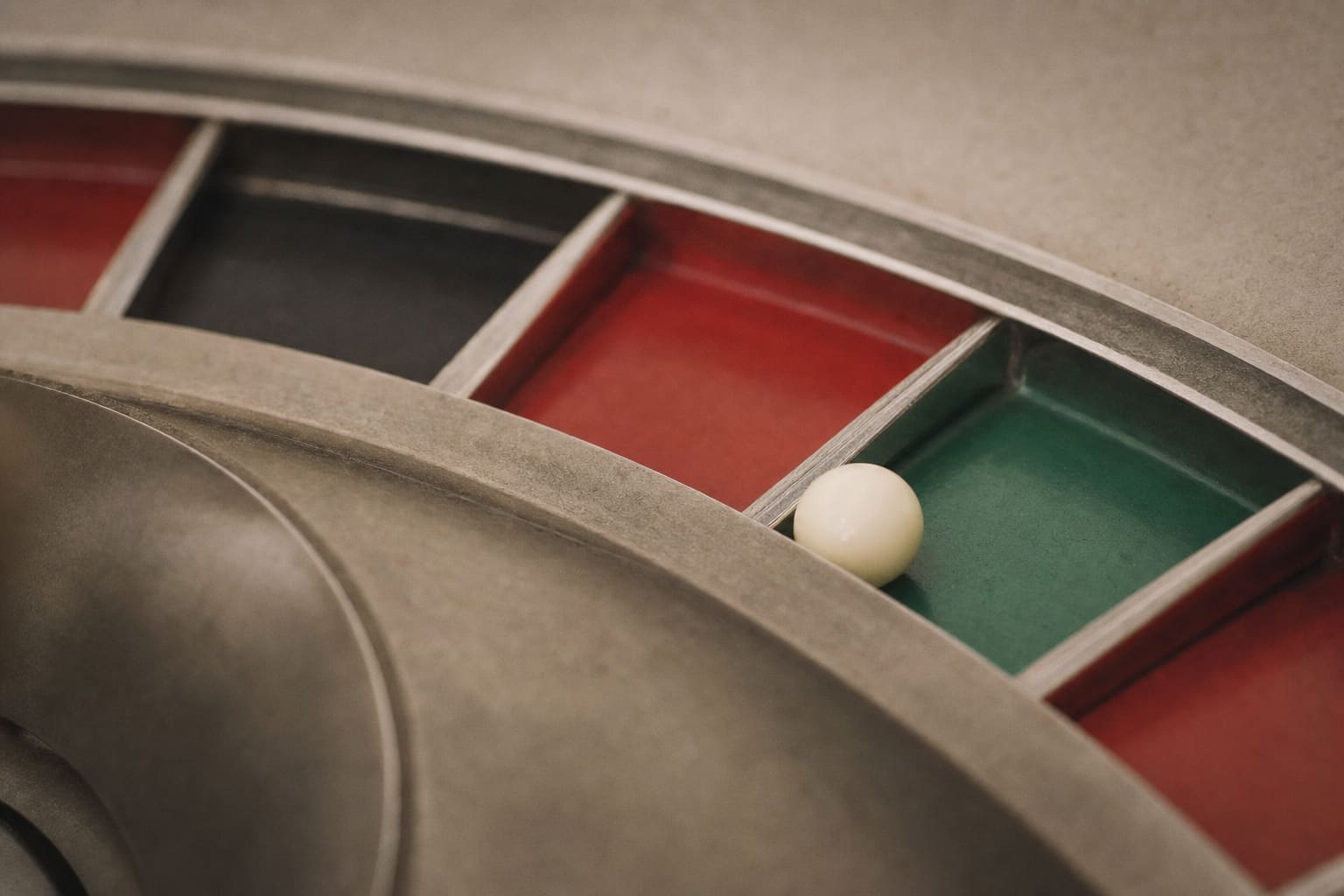
Everything in roulette comes back to one number. Get the roulette house edge explained clearly and every system, every myth and every “sure thing” falls into place. This page builds the edge from first principles, shows why it differs by wheel, and explains how to make the odds as favourable as they can be.
What the roulette house edge actually is
The roulette house edge is the fraction of every wagered dollar the casino expects to keep over the long run. It is not a fee, not a commission, and not something the dealer decides — it is baked into the relationship between how often a bet wins and what it pays when it does. Understanding the roulette house edge is the single most useful thing you can do before choosing any strategy, because it sets the ceiling on what is possible.
Where the 2.70% comes from
A European wheel has 37 pockets: numbers 1 to 36 plus a single green zero. Bet one unit on a single number and, if it wins, you are paid 35:1. But there are 37 possible outcomes, so the true odds against your number are 36:1. If the payout matched the true odds, roulette would be a fair game with no edge. It does not. That missing unit — 35 paid where 36 is fair — spread across all 37 pockets works out to exactly 1 ÷ 37 = 2.70%. That is the roulette house edge, and on a European wheel every standard bet carries it.
Why the American wheel doubles the odds against you
The American wheel keeps every payout the same but adds a second green pocket, the double-zero (00). Now there are 38 pockets, and the straight-up bet still pays 35:1 against true odds of 37:1. The shortfall is two units across 38 pockets: 2 ÷ 38 = 5.26%. Same bets, same chips, nearly twice the long-run cost. This is the clearest lesson in roulette odds there is: the house edge lives in the pockets, not the bet you pick. If you have a choice of wheel, the European or French table is always the better roulette odds.
How French rules cut the edge to 1.35%
French roulette runs on a single-zero wheel but adds a rule that helps you: la partage. On an even-money bet (red/black, odd/even, high/low), if the ball lands on zero you lose only half your stake instead of all of it. A related rule, en prison, holds the stake for one more spin instead. Either way, the even-money house edge is halved to 1.35% — the best roulette odds available on a standard table. It only applies to even-money bets, but those are exactly the bets most systems use.
What the edge costs in practice
The roulette house edge is a rate, so its real cost depends on how much and how fast you bet. A rough hourly figure is edge × average bet × spins per hour. On a European wheel, betting $10 a spin for 40 spins an hour, the expected loss is 0.027 × 10 × 40 ≈ $11 an hour. Move to an American wheel and that roughly doubles. Slow down, bet less, or pick a lower-edge wheel and the number shrinks. No betting system changes this rate — it only changes how the losses are distributed around it.
Every bet on the layout lands on the same 2.70%
The straight-up number is the easy case to picture, but the same shortfall hides in every other bet on a European table. Cover two numbers with a split and the payout drops to 17:1. Cover four with a corner and it drops to 8:1. Back a whole dozen and you get 2:1. Each time, the payout shrinks in step with your improved chance of winning, and each time the casino keeps the same slice. Work through the arithmetic and every bet collapses onto one figure.
| Bet | Numbers covered | Payout | True odds | House edge |
|---|---|---|---|---|
| Straight-up | 1 | 35:1 | 36:1 | 2.70% |
| Split | 2 | 17:1 | 17.5:1 | 2.70% |
| Corner | 4 | 8:1 | 8.25:1 | 2.70% |
| Dozen / column | 12 | 2:1 | 2.083:1 | 2.70% |
| Red/black, odd/even | 18 | 1:1 | 1.056:1 | 2.70% |
The green zero is the reason every row ends in the same place. It sits outside all of these bets, so whatever you pick, one pocket always pays nobody but the house. If you want to see which chips cover which pockets, the inside and outside bets guide lays them out.
House edge and volatility are not the same thing
People often blur the roulette house edge with how wild the swings feel, but the two measure different things. The edge is the average — the slow, steady tilt that pulls results toward the casino over thousands of spins. Volatility, or variance, is the size of the bumps along the way. A straight-up bet and an even-money bet carry an identical 2.70% edge, yet they feel nothing alike. The single number pays 35 times your stake and hits rarely, so a bankroll lurches up and down. Red or black wins close to half the time in small, frequent steps.
Volatility is what lets a player walk away ahead for a night, or lose a stake in ten minutes. Over a short session the swings dominate and the edge is almost invisible. Give it enough spins and the swings average out while the edge keeps grinding — which is why a long session tracks the maths far more closely than a quick one. Understanding that gap is the difference between reading a lucky hour as skill and reading it as noise.
Why nothing on the felt gets around it
Because every bet shares the same edge, no arrangement of bets can cancel it. Split a chip across red and black to “cover more of the table” and the zero still takes both when it lands. Chase losses by doubling up after each one and you only reshape where the wins and losses fall — the Martingale and its relatives change the rhythm of a session, never the long-run rate. The same holds for the wheel itself: the pockets are fixed the moment you sit down, and the one lever you actually control is which table you choose. That is the entire case for comparing European and American wheels before you play.
The roulette house edge explained: the bottom line on roulette odds
Roulette odds are fixed and knowable. The roulette house edge explained here is not a secret the casino hides; it is published in the payout table for anyone who cares to divide. Your leverage is not in beating it but in choosing the smallest edge available: a single-zero European wheel at minimum, a French table with la partage where you can find one, and even-money bets to take advantage of those rules. Then read the betting systems to decide how to structure your play — knowing, now, exactly what they can and cannot do.
Frequently asked questions
What is the roulette house edge?
The house edge is the share of every bet the casino keeps on average over time. On a European wheel it is 2.70%; on an American wheel 5.26%. It comes from paying wins as if the green zero pockets did not exist.
Why is the European house edge exactly 2.70%?
There are 37 pockets but a straight-up win pays 35:1 instead of the true 36:1. That one-unit shortfall divided across 37 pockets is 1/37 = 2.70%.
Why is the American house edge higher?
The American wheel adds a second green pocket (00), making 38 pockets while payouts stay the same. The shortfall becomes 2/38 = 5.26%, nearly double the European edge.
What is the lowest possible roulette house edge?
1.35% on even-money bets at a French table with la partage or en prison, which return half your stake when the ball lands on zero.
Does the house edge change between bet types?
On a European wheel, no — every standard bet carries the same 2.70% edge. The rare exception is the American five-number bet, which is worse at 7.89%.
Does the house edge mean I will always lose?
Not every session. It is a long-run average. In the short term anything can happen, which is why people win sometimes — but over thousands of spins results converge on the edge.
Can a betting system lower the house edge?
No. Systems like the Martingale rearrange when you win and lose but never touch the edge itself.
How much does the house edge cost per hour?
Roughly: (edge) × (average bet) × (spins per hour). At 2.70%, a $10 average bet and 40 spins an hour is about $11 an hour in expected loss.
Is the house edge the same as RTP?
They are two sides of one coin. RTP (return to player) plus house edge equals 100%. A 2.70% edge is a 97.30% RTP.
What is en prison?
A French rule: on an even-money bet, if the ball lands on zero your stake is 'imprisoned' for one more spin instead of lost. It has the same effect as la partage, halving the even-money edge to 1.35%.
Does the house edge apply to live dealer roulette?
Yes, identically. A live-streamed physical wheel has the same pockets and payouts, so the same edge applies.
Do the odds improve if I bet on more numbers?
No. Covering more numbers raises your win chance but lowers the payout by the same proportion, leaving the edge unchanged. It only reduces variance.
Is roulette the worst casino game for house edge?
American roulette is among the higher edges. European roulette at 2.70% is middling, and French roulette at 1.35% on even-money bets is genuinely competitive.
How do I get the best roulette odds?
Play European or French single-zero wheels, use even-money bets where la partage applies, and avoid American double-zero tables. See European vs American roulette.
Where can I see payouts against true odds?
The bet explorer on the home page shows each bet's payout beside its fair odds, and the bet types page lists the full table.