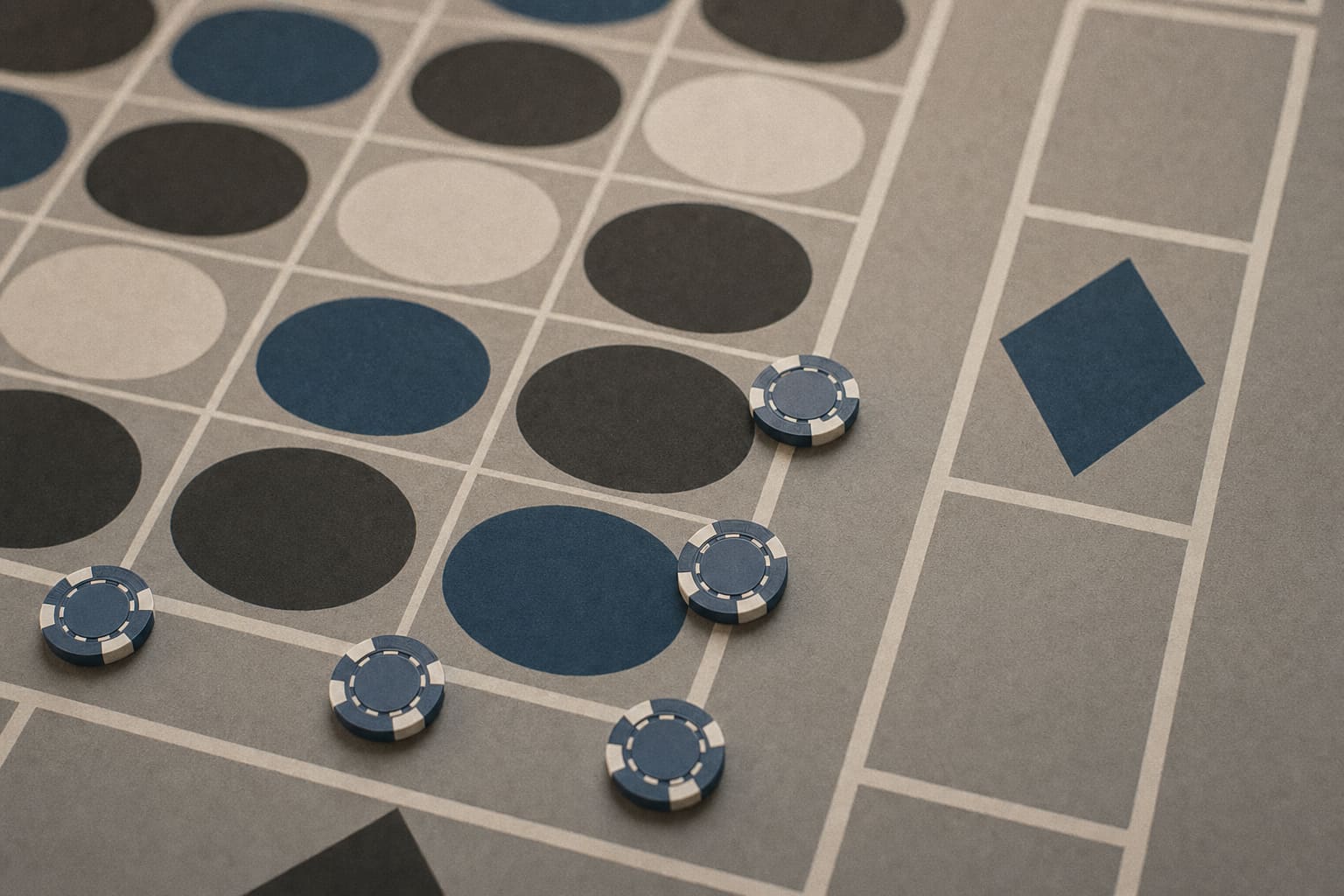
Every chip you place in roulette is either an inside bet or an outside bet, and knowing the difference is the foundation of reading the table. The short version: inside bets pay big and win rarely; outside bets pay small and win often. Crucially, on a European wheel they all carry the same house edge — so the choice is about variance, not value.
Inside bets
Inside bets sit on the numbered grid itself and target specific numbers or tight clusters. They are the high-payout, low-frequency end of the table.
| Bet | Numbers covered | Pays | Win chance (European) |
|---|---|---|---|
| Straight-up | 1 | 35:1 | 2.7% |
| Split | 2 | 17:1 | 5.4% |
| Street | 3 | 11:1 | 8.1% |
| Corner | 4 | 8:1 | 10.8% |
| Six-line | 6 | 5:1 | 16.2% |
Outside bets
Outside bets sit around the edge of the layout and cover large groups. They are the low-payout, high-frequency end — the home of most betting systems, because their near-even chances suit progressions.
| Bet | Numbers covered | Pays | Win chance (European) |
|---|---|---|---|
| Dozen (1–12, etc.) | 12 | 2:1 | 32.4% |
| Column | 12 | 2:1 | 32.4% |
| Red / Black | 18 | 1:1 | 48.6% |
| Odd / Even | 18 | 1:1 | 48.6% |
| High / Low | 18 | 1:1 | 48.6% |
Why they all share the same edge
It looks as though the straight-up bet, paying 35:1, must be “worse value” than an even-money bet paying 1:1 — or better. Neither is true. Each payout falls short of its true odds by exactly the same proportion, which is why every bet on a European wheel carries the identical 2.70% house edge. Choosing inside or outside bets changes only your variance: inside bets deliver rare, large wins; outside bets deliver frequent, small ones. Your expected loss over time is the same either way.
Where the edge actually comes from
The single 2.70% figure is not a house rule bolted on top; it falls straight out of the gap between what a bet pays and what it should pay. A European wheel has 37 pockets, so a fair payout on a single number would be 36:1 — stake one unit, and a true-odds win would return 36 to leave the long-run result flat. The casino pays 35:1 instead. That one-unit shortfall, spread across the 37 equally likely pockets, is the entire edge. Run the same arithmetic on any other bet and the answer never changes.
| Bet | Pays | True odds (European) | Effective edge |
|---|---|---|---|
| Straight-up | 35:1 | 36:1 | 2.70% |
| Split | 17:1 | 18:1 | 2.70% |
| Corner | 8:1 | 9:1 | 2.70% |
| Dozen / column | 2:1 | 2.083:1 | 2.70% |
| Even-money | 1:1 | 1.056:1 | 2.70% |
Every row lands on the same number because the shortfall is always proportional to the payout. This is why chasing “better-paying” bets is a mirage — a bigger payout simply comes with a proportionally smaller chance, and the house keeps the same slice of every stake. The full derivation lives in roulette house edge explained.
Which bets suit which player
Because value is identical, the honest way to choose between inside and outside bets is by the kind of session you want. Outside even-money bets — red/black, odd/even, high/low — win almost half the time and pay 1:1, so they produce long, gentle sessions with small swings. That is exactly why nearly every betting system is built on them: a progression needs frequent, near-even results to work its stake plan, and it needs the room a low-variance bet allows before the stakes run away. The even-money bets are also the only ones the French la partage rule touches, halving their edge to 1.35% when the ball hits zero.
Inside bets are the opposite trade. A straight-up number pays 35:1 but lands roughly once in every 37 spins, so a session on single numbers is mostly near-misses punctuated by the occasional large hit. Splits, corners and six-lines sit between the two extremes, letting you dial variance up or down by covering more or fewer numbers. A flat spread like the James Bond strategy is really just a fixed combination of these bets chosen to cover a wide slice of the wheel in one go.
Announced and combination bets
At many European and French tables you will also see announced bets — fixed groups of numbers based on their position around the wheel rather than the layout, such as Voisins du Zéro, Tiers du Cylindre and Orphelins. They are simply pre-set combinations of inside bets placed in one call, and they carry the same 2.70% edge as everything else; their appeal is convenience and the neighbours-of-the-wheel pattern, not any change in value. Beginners rarely need them, but recognising the names helps when reading a busy table.
You can see the payout-versus-odds relationship directly in the bet explorer on the home page, which lines up each bet’s payout against its fair odds. For the maths behind it, read roulette house edge explained, and for the special rules that lower the edge on even-money bets, see the rules page.
Frequently asked questions
What is the difference between inside and outside bets?
Inside bets are placed on individual numbers or small groups inside the number grid; they pay more but win less often. Outside bets cover large groups like red/black or dozens; they pay less but win more often.
Which bets have the best odds?
On a European wheel every standard bet carries the same 2.70% house edge, so none has better odds than another. Outside even-money bets have the highest win chance (48.6%) but the smallest payout.
What does a straight-up bet pay?
35:1. It covers a single number and wins about 2.7% of the time on a European wheel.
Are outside bets safer?
They are lower variance — you win more often for less. That feels safer, but the expected loss rate (the house edge) is identical to inside bets.